 16
16Whoever receives a load from a carrier must check it and complain on the spot, or lose the right to do so; damage that cannot be seen at first sight has to be reported within 10 days of delivery (Brazilian Civil Code, art. 754).
On site, the person standing in front of the truck at that moment is the storekeeper (almoxarife). What he counts, looks at and signs during unloading decides whether C&S Engenharia pays for what it received or for what was written on the invoice. This text describes the seat from the side of whoever executes the works: receipt, stock and storeroom safety. The reading is C&S Engenharia's, marked as such; the rules cited appear in the references at the end.
Materials, tools and equipment. Everything the site uses passes, at some point, through the storekeeper's hands. He receives, checking quantity, quality and invoice against the order. He stores, properly and safely. He controls the stock: receipts, issues, requisitions, inventory counts, losses and surpluses. He delivers to the site what each work front asked for. And he records every step, so that anyone can retrace the path of a bag of mortar from the truck to the wall.
The purchase is decided elsewhere. But it is in the storeroom that it becomes a thing: a pallet, a bar, a drum, a box. It is also there that cost leaks when there is no control. It does not leak all at once. It leaks through deliveries accepted without counting, tools that leave without a signature, surpluses forgotten in a corner of the site.
In C&S Engenharia's reading, a well-run storeroom does not draw attention. The work front finds the material when it needs it, payment goes out for what actually arrived and the inventory count closes with a small, explained difference. Silence is the result.
The signature on the delivery document is the moment the site says "received". After it, any complaint becomes harder. That is why the check happens with the truck still parked and the driver present.
| Check | What to look at | If it does not match |
|---|---|---|
| Invoice | Authenticity and authorisation of the electronic invoice; items, quantities and prices against the order | Alert supply management before unloading |
| Quantity | Count of pallets, pieces or bags; weight or volume where relevant | Note the shortfall on the delivery document, with the exact number |
| Condition | Breakage, moisture, dents, broken packaging | Reject the damaged part or note a reservation, with a photo |
| Specification | Material identical to the order; expiry date; certificate where required | Do not accept substitutions without written authorisation from the buyer |
| Protective equipment | Certificate of Approval (CA) on the product or packaging | Reject: without the certificate, the equipment cannot be used |
Each line rests on a rule. SINIEF Adjustment 07/05, which governs Brazil's electronic invoice (NF-e), requires the recipient to verify the validity and authenticity of the invoice (tenth clause, § 1) and provides for the recipient to record whether the transaction took place "exactly as stated" or did not take place (fifteenth-A clause, § 1). That record is only true if someone checked the load.
Law 9,933/1999 requires goods subject to technical regulation to comply with it (art. 1) and extends the duty to whoever uses, stores or transports them (art. 5). NR-6 requires buying only protective equipment approved by the competent national body (item 6.5.1, a), and Brazil's Consolidated Labour Laws (CLT) forbid using equipment without a Certificate of Approval (art. 167).
The Civil Code completes the picture with deadlines. Besides the ten days against the carrier, there are thirty days to reject movable goods with a hidden defect, counted from actual delivery, or from discovery, up to one hundred and eighty days (arts. 441 and 445). And the risk passes to a buyer who delays receiving what was made available at the agreed time and place (art. 492, § 2). A truck waiting at the gate because nobody is there to receive it also has a cost.
In the structure C&S Engenharia describes, the storekeeper is linked to supply management by a dotted line: functional coordination, with no direct reporting line. Supply management sets the standard for purchasing, supplier registration, receipt and reconciliation. The storekeeper follows that standard and reports back what happens in the storeroom: what arrived, what left, what is left over, what is missing.
Supply management can work without being physically present on each site. The storekeeper is, precisely, the eyes and hands for what comes in and what goes out. Without him, the next purchase is made on a balance nobody counted.
The storekeeper's direct reporting line follows each company's structure. Day to day, he works with four people. The resident engineer approves unplanned requisitions and decides priorities when material is short. The site foreman (mestre de obras) requests material for each front and returns what is left over. The site administrative assistants take invoices and documents to the office. The site administrator looks after documentary compliance and compares one site with another.
Above that, the general coordinator receives the supply picture for every site without opening a stock card. When a low balance threatens a work front, the information goes up in time for someone to decide.
A site storeroom is a place of risk: weight, height, chemicals, people and loads moving around. NR-18, the Brazilian safety standard for construction, requires materials to be stored so as not to cause accidents, not to obstruct the passage of people and materials and not to block access to fire extinguishers or emergency exits (item 18.16.4).
The same standard requires timber taken from scaffolding, hoardings, formwork and shoring to be stacked only after nails, wires and straps have been removed or bent flat (item 18.16.4.1). Toxic, corrosive, flammable or explosive materials stay in an isolated, signposted area, with access only for authorised people and the product safety data sheet available (item 18.16.5).
NR-11, which covers the movement and storage of materials, puts numbers on it. The stored weight cannot exceed the load capacity of the floor. Stacked material stays at least 0.50 m from the side structures. And each type of material follows its own special safety requirements (items 11.3.1, 11.3.3 and 11.3.5).
Anyone operating a forklift or other motorised transport equipment needs training given by the company and an identification card with name and photograph, valid for one year (items 11.1.5, 11.1.6 and 11.1.6.1). The storekeeper does not hand the machine to anyone without the card.
For chemicals, NR-26 requires the manufacturer to make a safety data sheet available for every product classified as hazardous (item 26.4.3.1) and the organisation to ensure workers have access to those sheets (item 26.5.1). In practice, the sheet stays where the product stays.
Material that leaves without paperwork is material that drops out of control. The requisition is the request from the site foreman or team leader to the storeroom: what, how much, for which work front and who collected it. It is what allows actual consumption to be compared with planned consumption and waste to be found early.
A surplus is also a movement. Material that comes back from the work front re-enters the stock, with a record, and is available for the next stage or another site. A surplus that does not come back becomes rubble or disappears.
Accounting gives weight to this discipline. The Brazilian accounting pronouncement on inventories, CPC 16 (R1), requires "all losses of inventories" to be recognised as an expense in the period in which they occur (item 34), and leaves the "abnormal amount of wasted materials" out of the cost of material (item 16, a). Without requisitions, nobody can say what was consumption and what was loss.
In a real estate development, the material also has an owner: the project that paid for it. IncorpBuilding covers that side of the seat, the reporting on each project. For the builder's storekeeper, the consequence is practical: the stock card says which site each material belongs to, and every transfer is recorded.
The storeroom is also the counter for tools and personal protective equipment (PPE). NR-18 requires the employer to supply the necessary hand tools free of charge, and the worker to look after them and return them when asked (items 18.10.2.17 and 18.10.2.17.1). When not in use, tools are kept in an appropriate place and carried in proper containers (items 18.10.2.18 and 18.10.2.20).
For PPE, NR-6 requires the organisation to supply it free of charge, suited to the risk, to record the supply in a book, card or electronic system and to replace it immediately when damaged or lost (item 6.5.1, c, d and g). An electronic system, if adopted, must allow reports to be extracted (item 6.5.1.1). The worker is responsible for keeping and maintaining it and reports when the equipment is lost or damaged (item 6.6.1, c and d).
The CLT completes the logic. Refusing without justification to use the PPE supplied is misconduct by the employee (art. 158, sole paragraph, b). And deducting from wages for damage caused by the employee is lawful only if it was agreed or if there was intent (art. 462, § 1). Without a handover record and a prior agreement, a tool that disappears is a company cost.
When the record uses biometrics, as NR-6 allows, Brazil's data protection law (LGPD) applies: biometric data is sensitive personal data (art. 5, II). The law allows it to be processed without consent when essential to comply with a legal obligation (art. 11, II, a), and only to the minimum necessary (art. 6, III). C&S Engenharia has already described PPE control in a separate text, in Portuguese.
However good the record, the physical stock and the stock on the card drift apart over time. A forgotten requisition, a breakage nobody noted, a delivery entered twice. The inventory count is what brings the two back to the same number.
In C&S Engenharia's reading, counting pays off most when it is frequent and partial: a few items each week, starting with the most valuable and the fastest moving. Any difference found is investigated while memories are still fresh. After three months, nobody remembers where the forty bags went.
Good storage also prevents losses. The public procurement law, which private construction is not obliged to follow, works as a yardstick when it requires purchase planning to consider "storage conditions that do not allow the material to deteriorate" (Law 14,133/2021, art. 40, IV). Cement that hardens and steel that rusts on the ground are money lost before it reaches the wall.
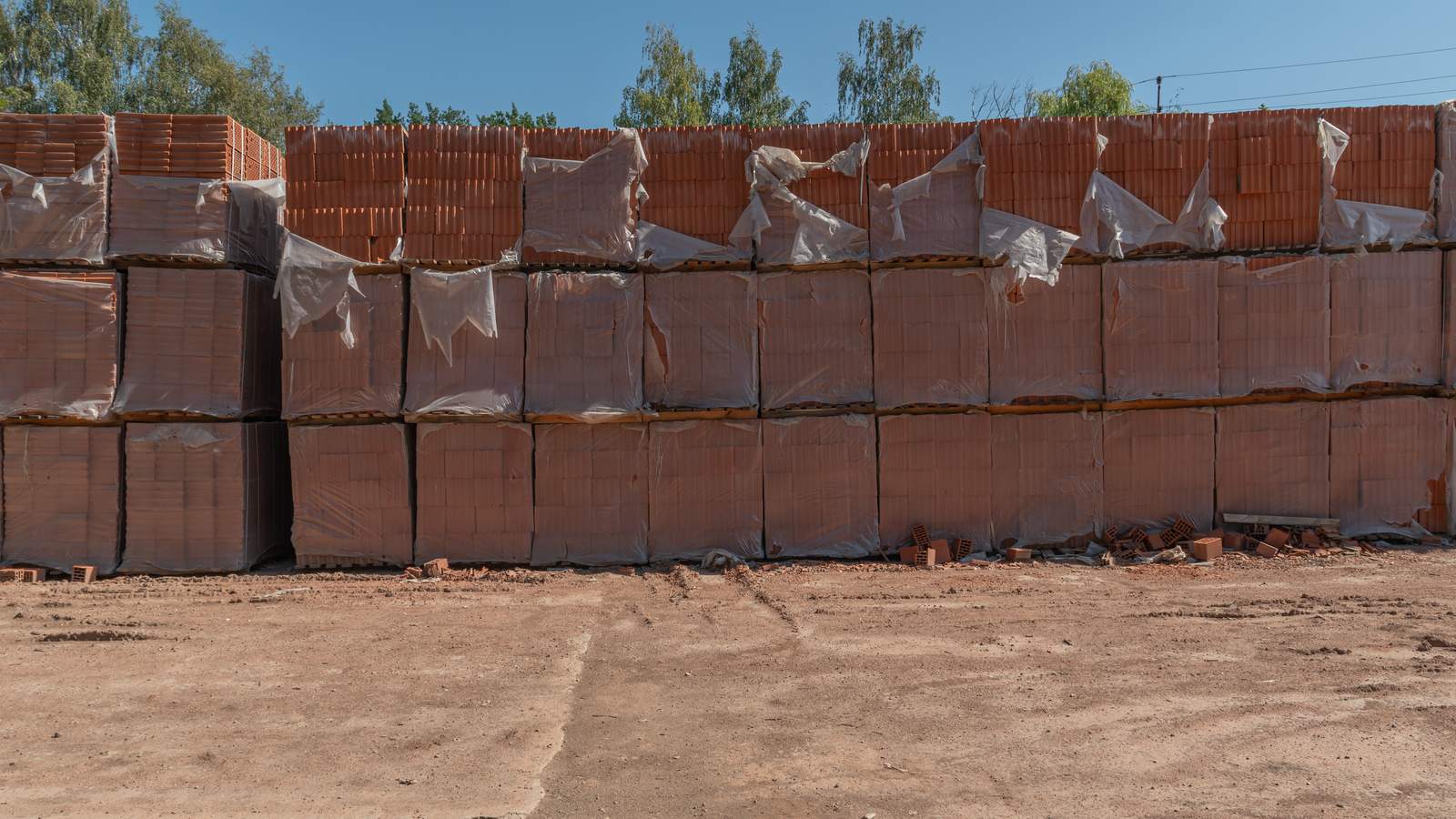
The example is hypothetical. The assumptions are the author's, chosen to make the arithmetic easy, and do not describe a real site or market prices. In a month of masonry, the site receives ten deliveries of ceramic blocks. Each delivery has 20 pallets of 200 blocks, or 4,000 blocks, at R$ 2.10 per block. Over the month, that is 40,000 blocks and R$ 84,000 invoiced.
| Occurrence (assumption) | Deliveries | Blocks per delivery | Blocks | Value |
|---|---|---|---|---|
| One pallet short | 3 | 200 | 600 | R$ 1,260 |
| 2% broken, visible at unloading | 2 | 80 | 160 | R$ 336 |
| Total paid without receiving | 760 | R$ 1,596 |
Without checking, the site pays R$ 1,596 for 760 blocks that did not arrive or arrived broken: 1.9% of what was invoiced that month. The shortfall only appears weeks later, when the masonry needs more blocks than the design planned and someone wrongly concludes that the crew's waste has gone up.
By counting pallets and looking at the blocks during unloading, both occurrences are noted on the delivery document, on the spot. Supply management claims the difference from the supplier before paying. The cost of the check is the time it takes to count twenty pallets.
Yes, but control loses strength. Whoever buys and also receives is checking his own work. In the structure C&S Engenharia describes, buying stays with supply management, and the storekeeper is linked to it by a dotted line, checking on site what was bought. The direct reporting line follows each company's structure.
Before signing, reject the damaged part or note a reservation on the delivery document, with a photo and the quantity, and alert supply management the same day. If the damage only shows up later, the deadline to report it to the carrier is ten days from delivery (Civil Code, art. 754). Against the seller, a hidden defect in movable goods has thirty days.
Only in two cases: if the possibility of a deduction was agreed beforehand or if the employee acted with intent (CLT, art. 462, § 1). That is why tools leave with a handover record and the rules for keeping and returning them are written down. NR-18 already requires the worker to look after the tool and return it when asked.
Yes. NR-6 accepts a book, card or electronic system, including biometric ones, and requires the system to allow reports to be extracted (items 6.5.1, d, and 6.5.1.1). With biometrics, the LGPD treats the data as sensitive; processing is allowed to comply with the legal obligation, keeping only what is necessary.
In an isolated, signposted and suitable area, with access only for authorised people and the safety data sheet for each product available (NR-18, item 18.16.5). NR-26 requires the organisation to make sure workers have access to those sheets. The area must not block fire extinguishers or emergency exits either.
By Raphael Schifino, CVO
← Back to Articles